
Governor Newsom Signs Three Troubling Housing Bills
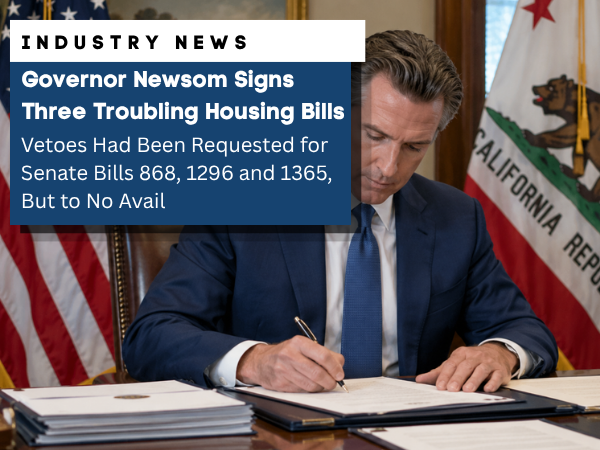
Vetoes Had Been Requested for Senate Bills 868, 1296 and 1365, But to No Avail
By Daniel Yukelson, Chief Executive and Executive Director
Three new housing bills taking effect on January 1, 2027, were signed into law by Governor Newsom, with two signatures occurring on the very last day to do so, on September 30, 2026. The three problematic and potentially harmful new laws were adamantly opposed by the Apartment Association of Greater Los Angeles from the very first day they were published, through committee and floor sessions in both houses of the legislature, and then to the vetoes requested from the Governor.
Unfortunately, despite expressed concerns about housing supply and affordability, and calls to protect smaller owners, by state and local legislators, it is clearly obvious all of that is “just talk.”
Here’s a rundown of the three new laws, Senate Bills 868, 1296 and 1365:
Senate Bill 868
Senate Bill 868. Senate Bill 868, which is informally known as the “Plug into the Sun Act,” was introduced by Senator Scott Wiener, who is now running for the U.S. Congress. This new law allows homeowners and renters to set up “portable solar generation devices” at a property to power electric devices.
The law defines “portable solar generation devices” as photovoltaic devices, which are devices that convert sunlight directly into electricity, that are designed to be connected to a building’s wiring through a receptacle and able to offset on-site electricity consumption. The law says a single dwelling can have devices with total AC output of no more than 1,200 watts, which must be certified by UL Solutions or an equivalent testing laboratory.
The goal of expanding access to renewable energy and to reduce electricity costs is a worthy one. However, Senate Bill 868 removes important safety oversight for portable solar electric generation devices that are fed directly into a building's electrical system through a standard electrical outlet, limiting an electric utility's ability to impose safeguards. Interconnection standards provide critical safety standards that ensure distributed generation equipment is properly configured and installed and does not cause hazards for residents, utility workers, or the electrical grid.
The Senate’s analysis of Senate Bill 868 identified concerns including overcurrent, fire, electric shock, failure of existing safety devices, and risks to ground-fault circuit interrupters. The Senate’s report further noted that distributed energy resources that are not properly reported can complicate and delay outage restoration. These concerns are particularly significant because portable solar systems are fundamentally different than ordinary appliances. Unlike a device that simply consumes electricity, a plug-in photovoltaic system can send electricity back through a building's electrical circuits, and improperly configured equipment can create fire and safety risks that may not be apparent to a resident or property owner. These safety concerns were left unresolved in the final version of this bill.
Moreover, Senate Bill 868 creates significant concerns for rental housing providers. The bill is specifically intended to expand balcony and plug-in solar access to renters and other residents. These systems may involve mounting equipment on balconies or other sections of a residential property. Property owners and managers have responsibilities to protect building infrastructure and the safety of residents, but Senate Bill 868 limits utility company oversight that would ensure distributed generation equipment is safely connected and operated.
Finally, the aesthetics of mounting multiple solar devices onto the outside of buildings and the likely web of wiring connecting them to wall outlets or electric-powered devices will not be pleasant.
Senate Bill 1296
Senate Bill 1296. Senate Bill 1296 by Senator Durazo is a complicated pet policy disclosure law, which, if not fully complied with, could result in legal exposure or become an affirmative defense for your renters in an unlawful detainer lawsuit. Senate Bill 1296 will cause many rental housing providers who have allowed pets at a property to reconsider and adopt a very simple pet policy: “NO PETS ALLOWED.”
Under Senate Bill 1296, housing providers who accept pets will need to comply with the following general provisions:
- Requires rental housing providers to have a pet policy or pet addendum in writing and to provide access to that pet policy or pet addendum on the property’s internet website, but only to the extent that the third-party website provider permits the inclusion of a hyperlink or other electronic access, in digital advertisements under the complete control of the housing provider, and in information provided to a residential rental search engine.
- Requires a rental housing provider to provide a written copy of the property’s established pet policy or pet addendum with any rental application form.
- Requires a pet policy or pet addendum to include specified information, including a description of the rights, responsibilities, and requirements for tenant pet owners at the property.
- A rental housing provider may amend an established pet policy or pet addendum for prospective tenants only and requires that a rental housing provider must provide the established pet policy in effect at the time the rental application form is provided to a prospective applicant.
If before charging an application fee a rental housing provider fails to disclose the established pet policy or pet addendum in accordance with this new law, and because of this failure to disclose the pet policy or pet addendum information the applicant is no longer eligible to rent the unit or declines to proceed with the application, the rental applicant may request a refund of the application fee by written notice, and the housing provider must refund the application fee within seven business days after receiving written notice.
However, refund of an application fee is not the only remedy. Senate Bill 1296 also includes a private right of action for damages, penalties, injunctive relief, and attorney's fees, which potentially expose housing providers to unforeseen legal liability. Senate Bill 1296 offers no stated remedy limitations and no cure period beyond a narrow "non-material error" safe harbor. Accordingly, Senate Bill 1296 is an invitation to derivative claims under Business and Professions Code Section 17200 and to affirmative defenses raised in unlawful detainer proceedings.
Make your new pet policy: NO PETS ALLOWED. For Apartment Association of Greater Los Angeles members, we offer an expanded pet policy and a pet addendum in our Forms Library.
VISIT THE FORMS LIBRARYSenate Bill 1365
Senate Bill 1365. Senate Bill 1365 by Senator Ben Allen extends California’s declared emergency, anti-price gauging restrictions to lease terms that are longer than one year, and further limits exceptions to the ten percent (10%) price limits (“caps”) when costs had been incurred in excess of normal repairs and maintenance. The bill also limits the added allowable increase for providing a furnished rental unit to only an additional five percent (5%) above the ten percent limit.
Senate Bill 1365 changes how housing providers have been able to defend certain rent increases above the 10% declared emergency limit, which provided an affirmative defense when a renter had agreed to the increase before the emergency declaration, or when an increase could be directly tied to costs for repairs or additions beyond normal maintenance and repairs. However, under the new law, any such “over and above” maintenance and repairs must be incurred within the year before the emergency declaration, and applicable only if:
- A rental housing was rented, advertised for rent or offered for rent at the time the costs were incurred; or
- A rental housing provider can prove that, within a year before the emergency declaration, they already intended to offer the housing for rent within six months of the completed repair or addition.
For any property operating under a strict rent control regime with rents that are far below market, Senate Bill 1365 makes catching up to market difficult when a vacancy occurs during a declared emergency.
In effect, Senate Bill 1365 imposes vacancy control by limiting rent increases during declared emergencies to no more than ten percent (10%) unless a housing provider can “thread the needle” on the now very limited safe harbor exemption.
For a state like California, which already has extensive renter protections, imposing statewide rent limits beyond Assembly Bill 1482, local rent control ordinances, and existing emergency price gouging restrictions merely adds yet another layer of regulation and increased compliance complexity along with the risk of inadvertent violations under a criminal statute.
Daniel Yukelson is currently the Chief Executive and Executive Director of the Apartment Association of Greater Los Angeles (AAGLA).
About the Apartment Association of Greater Los Angeles (AAGLA)
Serving rental housing providers throughout Southern California since 1917, AAGLA is a leading trade association and government advocate. With over 10,000 members representing more than 350,000 rental units, our community includes rental property owners, managers, developers, real estate professionals, and trusted vendors. AAGLA also offers comprehensive member-exclusive education and training, including weekly webinars, in-person events, Lunch & Learn sessions, and Certificate programs covering legal updates, landlord-tenant laws, insurance, and more.
Not a member of AAGLA? Click here.
LEARN ABOUT AAGLA MEMBERSHIP