
The Year in Review: Local Housing Ordinances Passed During 2025
The Year in Review: Local Housing Ordinances Passed During 2025
Important: This article is for informational purposes only. If you have any questions regarding your property or specific tenancy matters, and the requirements of any local regulatory changes described herein, please consult with an attorney.
City of Beverly Hills
One Year Minimum Lease Requirement
On July 15th, the City of Beverly Hills adopted a new ordinance for short-term rentals. The ordinance defines short-term rentals as any lease or sublease that is shorter than twelve (12) consecutive months and requires a minimum one-year initial lease term with the ability to revert to a month-to-month lease thereafter.
In addition to single-family, condominium and multifamily properties, this mandatory, one-year lease term is applicable to the leasing of guest houses, accessory dwelling units, or other accessory features on a property (game courts, pools, yards), but does not cover any in-home care giving activities.
City of Burbank
Seismic Retrofitting Ordinance and Related Council Actions
On March 11th, the Burbank City Council adopted a new anti-harassment ordinance that only protects renters.
On October 28th, the Burbank City Council voted to bring back an ordinance providing for a 4% annual rent increase limit that, if exceeded, would trigger a requirement to pay relocation fees (referred to as a “soft cap”).
Under the proposed ordinance, renters would be given the option to either (i) agree to pay the increased rent above the 4% cap or (ii) receive relocation fees from the rental housing provider in the amount of three (3) months’ rent based upon the new increased rental amount.
The proposed ordinance, if finalized, would apply to multifamily owners with properties that received certificates of occupancy prior to February 2, 1995.
At its December 10th meeting, the Burbank City Council unanimously passed a new mandatory earthquake retrofit ordinance for soft-story buildings (these are properties that have open space ground floor parking underneath habitable units with the total structure being at least two stories in height).
The new requirement went into effect immediately and provides a total timeline for completion of work of 5 years for completion.
Soft-story compliance timeline
- Submit screening forms by January 12, 2026
- Submit engineering plans by January 11, 2027
- Show approval of plans by January 10, 2028
- Obtain permits and begin construction by January 10, 2029
- Complete construction by January 10, 2030
In addition, owners will need to notify renters if the property is deemed seismically vulnerable and is being scheduled for earthquake retrofitting.
There is a maximum cost pass-through of $51.00 per unit, per month for a maximum of 120 months based on the costs of the retrofit. Advanced notice to renters of the pass-through is required.
The new soft cap rent limitation would also apply to all rental properties, including newer multifamily properties, single-family properties, accessory dwelling units, condominiums, and townhomes.
However, relocation fees would only be triggered if rent is increased above the statewide rent stabilization limits equal to the lesser of 10% or the Consumer Price Index plus 5% (currently 8% for Los Angeles County).
The relocation fees payable to tenants for such newer multifamily properties, single-family properties, accessory dwelling units, condominiums, and townhouses would be in the same amount as pre-February 2, 1995, properties, namely three (3) months of rent at the new increased rent amount.
In addition, staff was directed to bring back an ordinances addressing:
- Increasing relocation fees for No-Fault evictions based on various characteristics of individual renters (e.g., age, disability, etc.)
- Further restricting substantial remodels (defined under existing state law as major system repairs or removal of hazardous materials and strictly prohibiting only cosmetic improvements)
- Extending Just Cause limitations to all rental housing
- Providing additional information on imposing a rental registry
City of Claremont
Established Equitable Anti-Harassment Ordinance
On March 27th, the Claremont City Council voted unanimously to pass a new anti-harassment ordinance that protects all parties, landlords and renters, from wrongful harassment.
This is the first ordinance in the Southland to fairly recognize that rental housing providers should receive protection against wrongful harassment by renters as well as renters from other renters.
Also, the ordinance includes several additional actions specific to rental housing providers that are now prohibited.
The ordinance applies to ALL rental housing, including all multifamily, single-family, condominiums and accessory dwelling unit.
This ordinance went into effect on June 26, 2025.
Prohibited forms of harassment (examples)
- Threats by word or gesture with physical harm
- Disclosing or threatening to disclose immigration or citizenship status for any reason except as required by court order
- Repeated intentional acts or omissions of such significance to interfere with or disturb the quiet of the occupant (whether renter or onsite owner)
City of Cudahy
Minimum Economic Threshold to Evict
On October 7th, the Cudahy City Council passed a new eviction threshold ordinance that limits evictions unless and until outstanding rent exceeds the Fair Market Rent (FMR) as defined by the U.S. Department of Housing and Urban Development (HUD).
The ordinance went into effect immediately as an “urgency ordinance.”
In addition, under the ordinance’s just cause eviction rules, the new ordinance defines a “material term” within a lease agreement as provisions such as: (i) refusal to surrender possession after proper notice, (ii) violation of occupancy limits, and (iii) violation of a new term of the tenancy.
City of Culver City
RSO Updates
On November 10th, the Culver City Council discussed potential revisions to the Rent Control Ordinance (including renaming the ordinance to “Rent Stabilization Ordinance” versus “Rent Control Ordinance”) and Tenant Protections Ordinance.
Under the proposed revisions to the Rent Stabilization Ordinance, all fees imposed upon renters are included as part of and therefore limited by, the annual rent cap. In addition, the proposed changes would eliminate the existing pass-through of 50% for rental registry fees and add additional administrative burdens for rental housing providers.
Revisions under the Tenant Protections Ordinance would prohibit rental housing providers from moving into their units if ownership is held by a limited liability company or limited liability partnership as such would then no longer be deemed “natural persons.”
Further, proposed changes would also add additional administrative burdens and for the first time include duplex owners and accessory dwelling owners (a/k/a, “Rental Complex”) under its restrictions.
City of Glendale
Green Building and Energy Efficiency Requirements
On November 18th, the Glendale City Council passed a new ordinance that requires duplexes, town homes and single-family properties to install either a heat pump as the primary source for heating or conduct additional energy efficiency measures when replacing or newly installing air conditioner units for cooling.
In addition, air conditioning systems being replaced must also meet several new requirements under the ordinance.
The new ordinance became effective on December 18, 2026.
City of Los Angeles
Multiple New Ordinances, Including Lower Rent Increase Limits; Potential Maximum Indoor Air Temperature Mandate and More!
On January 7th, the Los Angeles City Council voted unanimously to officially establish a new fee of $31.05 per unit, per year for the newly created enforcement program applicable to ALL rental housing not currently covered by the City’s existing rent stabilization ordinance (RSO).
Accordingly, all property owners who have multifamily properties built after October 1, 1978, single-family homes, condominiums, townhouses, accessory dwelling units (ADUs) and Junior ADUs (collectively, “Non-RSO” properties) are covered under this new enforcement program.
The purpose of the new enforcement program is to regulate Non-RSO properties and hold rental property owners accountable to comply with several recently passed ordinances targeting owners of Non-RSO properties.
Hard copy bills are being mailed out by the Los Angeles Housing Department (LAHD) to owners.
The new fee of $31.05 per unit, per year is effective immediately and has an initial payment deadline of February 28, 2025, and If owners of Non-RSO properties fail to pay the new enforcement fee on time, the City Council has granted LAHD sole authority to set the amount for late payment penalties, which are to be set at 150%.
On April 1st, the Los Angeles City Council passed a permanent ordinance establishing a Right to Counsel Program that provides city-paid attorneys to defend low-income renters against legal evictions (a/k/a, Unlawful Detainers).
All Rental housing providers, including single-family properties, accessory dwelling units, condominiums and multifamily properties, will be required to provide notice to ALL renters of this new program once the Los Angeles Housing Department (LAHD) has created the notice, called Right to Counsel Program Notice (“RTCP Notice”).
The notice must be provided at the start of a tenancy, when an eviction notice is served and at other certain points in time related to housing subsidies.
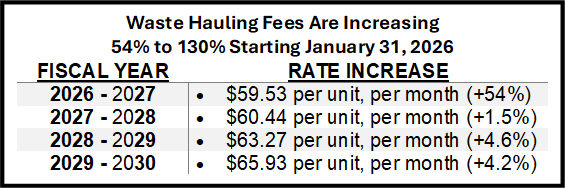
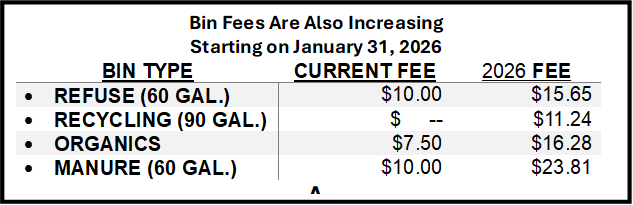
On April 11th, the Los Angeles City Council approved waste hauling increases of approximately 54% to 130%, or to $59.53 per unit per month starting January 1, 2026.
On October 1st, the Housing and Homelessness Committee for the City of Los Angeles passed a motion to consider a new indoor air temperature mandate requiring all rental housing providers to maintain 82 degrees Fahrenheit or cooler maximum indoor temperature for one or more habitable rooms without the ability to pass-through costs of compliance.
This proposal follows a similar mandate recently imposed for unincorporated areas of Los Angeles County.
The item is not yet final and will eventually be considered by the City’s Energy and Environment Committee before being given consideration by the full city council. [Further follow-up on this matter was pending as of the date this article was written.]
On November 12th, the Los Angeles City Council voted 10-to-2 to update the Rent Stabilization Ordinance (RSO) by adopting a drastically lower rent increase formula and methodology. The ordinance received final approval by a second 10-2 vote on December 13th.
Under the new formula, the following changes were made and are expected to go into effect sometime in 2026:
- Reduced the percentage of the Consumer Price Index (CPI) allowed from 100% to 90% (a 10% reduction).
- Reduced the maximum increase (“ceiling”) from 8% to 4% (a 50% reduction)
- Reduced the minimum increase (“floor”) from 3% to 1% (a 66% reduction)
- Eliminates the additional 1% each for gas and/or electricity for master metered properties that make up 20% of all RSO units
- Eliminates the additional 10% increase for additional occupants that are considered dependents of the renter on the lease.
In summary:

County of Los Angeles
Multiple Emergency Declarations
On January 21st, the Los Angeles County Board of Supervisors unanimously passed a resolution mandating that rental housing providers in the unincorporated areas of Los Angeles County to immediately allow unauthorized occupants and unauthorized pets of occupants who were “impacted by the January 2025 Windstorm and Critical Fire Events or who are aiding in recovery efforts” through May 31, 2026.
On November 25th, the Los Angeles County Board of Supervisors unanimously approved two storm emergency declarations, one authored by Supervisor Lindsey Horvath and one by Chair Kathryn Barger, respectively.
The ordinances trigger the County’s existing anti-price gouging ordinance restrictions. Chair Barger’s emergency declaration went into effect immediately while Supervisor Horvath’s became effective later but was to remain in place through and including December 28, 2025, but on December 9th, the ordinance was further extended through January 28, 2026, and could be further extended. Chair Barger’s motion was passed with no specified end date.
In general, under anti-price gauging rules, rental housing providers of any type of property, whether multifamily, single-family, condominium, townhouses, or accessory dwelling unit throughout the County may not increase rent by more than 10% until the end of the declared emergency.
Also, on February 11th, the Los Angeles County Board of Supervisors approved a motion that increases penalties up to a maximum of $50,000 for violating the County’s ordinance against increasing prices by more than 10% for housing and other goods and services during times of declared emergencies (e.g., anti-price gauging rules).
Previously, among other occasions, on October 14th, the Los Angeles County Board of Supervisors passed an ICE Emergency Declaration, which new declaration had gone into effect immediately.
Additionally, On February 25th, the Los Angeles County Board of Supervisors had approved an urgency resolution in response to the wildfires allowing qualified renters countywide to avoid paying legally owed rent for up to six months by instituting an eviction moratorium (a/k/a, eviction defense) if tenants are willing to sign a self-attestation that they had at least a 10% income impact (decline) from the wildfires.
City of Oxnard
Tenant Anti-Harassment Ordinance
On Tuesday, April 29th, the Oxnard City Council approved an anti-harassment ordinance that subjects all rental housing providers to statutory damages of $10,000 or actual damages, whichever greater, and punitive damages, attorneys’ fees and costs and jail time of up to six months for a single infraction.
Additionally, an additional penalty of $5,000 per violation would be applicable when a renter is a senior or is disabled.
These penalties are so outrageously extreme that any mom-and-pop rental housing provider could be driven into bankruptcy for a single violation.
On May 22nd, the Oxnard City Council officially adopted new fees applicable to ALL rental housing providers.
There will be a new rental registry fee of $138.77 per unit for all rental properties under the current rent stabilization ordinance (RSO) that applies to multifamily properties with certificates of occupancy issued on or prior to February 1, 1995.
This fee is scheduled to increase to $143.21 per unit for fiscal year 2025-2026 and $146.88 per unit for fiscal year 2026-2027.
For non-RSO properties, there will be a new Just Cause Ordinance enforcement fee of $69.39 per unit (JCO Fee) and Non-RSO property owners will now be required to register their properties with the City.
This JCO Fee is scheduled to increase to $71.60 per unit for fiscal year 2025-2026 and $73.44 per unit for fiscal year 2026-2027.
Non-RSO or “Just Cause Only” properties are those rental properties that fall outside of the RSO, meaning all single-family, condominiums, accessory dwelling units and newer multifamily properties with certificates of occupancy issued on or after February 1, 1995.
The City is providing a one-year amnesty period for subjecting rental property owners to late filing fees to expedite registration of all units.
This new fee ordinance was made effective on June 19, 2025.
On July 15th, the Oxnard City Council passed a new Tenant Anti-Harassment Ordinance (TAHO) applicable to all rental housing providers.
This ordinance took effect on August 14, 2025.
The TAHO applies to all rental housing providers, including multifamily, single-family, accessory dwelling units, and condominiums, and imposes statutory damages of $10,000 per violation or actual damages, whichever is greater, punitive damages and attorneys’ fees and costs.
In addition, violators may be subjected to criminal prosecution as a misdemeanor with jail time of up to six months for a single violation or a fine of up to $1,000 or both.
“Harassment” includes, but is not limited to, the following (Section 27-42 of the TAHO):
- a reduction or elimination of housing services
- a reduction of maintenance or failure to perform and timely complete necessary repairs or maintenance
- failing to exercise due diligence in performing and completing repairs to a rental housing unit after obtaining possession of the unit for the purpose of performing the repairs
- engaging in any act or omission which interferes with the tenant’s right to use and enjoy the rental unit
- refusing to acknowledge or accept receipt of lawful rent payments as set forth in the lease agreement or as established by the usual practice of the parties
- engaging in any act or omission constituting a disturbance of a tenant’s possession of rental premises, whereby the premises are rendered unfit for occupancy, or the tenant is deprived of the beneficial enjoyment of the premises
City of Pomona
Permanent Rent Stabilization
On November 17th, the Pomona City Council voted to pass a new permanent rent stabilization ordinance.
The new ordinance replaced the two prior urgency ordinances.
This ordinance takes effect on January 1, 2026.
The new permanent ordinance raises the fixed annual allowable increase from 4% to 5%.
However, it is still not tied to the Consumer Price Index. Therefore, when inflation is above 5%, owners will not be able to keep pace with rising costs.
City of Port Hueneme
Smoking Ban for Multifamily Properties
On August 18th, the Port Hueneme City Council approved an expansion of an existing City smoking ban to specifically include multifamily properties, including townhouses and condominiums.
The ordinance includes a complete smoking ban for all units, including owner-occupied units, and common areas.
The proposed ordinance does permit designated smoking areas on a property, and it bans both nicotine and cannabis smoke, and vaping and e-cigarettes.
Designated smoking areas must meet the following criteria:
- Smoking areas will be no less than 25 feet from playgrounds, building entrances and operable windows
- Smoking areas must be posted with at least one sign stating it is a “Designated Smoking Areas,”
- Smoking areas must contain ash cans allowing for proper disposal and property owner/manager must ensure cans are regularly maintained
Finally, property owners and managers who become aware of violations of the no smoking ban must take reasonable steps to investigate and enforce the regulations, including by providing written notice of the violation, a request to cease the violation and the course of action to be taken if the violation is not corrected.
City of Santa Monica
Non-RSO Registration Requirements and Building Performance Standards
On September 9th, the Santa Monica City Council voted unanimously to approve a new Building Performance Standards (BPS) ordinance that will force multifamily owners into eliminating gas appliances by requiring progressively lower levels of GHG emissions for buildings that are 20,000 square feet or larger.
Multifamily and commercial property owners must reduce emissions by eliminating gas appliances and/or energy efficiency measures.
The ordinance is to take effect on June 1, 2026.
According to the City staff report, there are 473 buildings in the category of 20,000 sq. ft. to 50,000 square feet that will be required to provide performance metrics for the first time as well as complying with new building performance standards (BPS) requirements.
On November 18th, the Santa Monica City Council unanimously passed a new ordinance that requires all rental housing providers to register all rental units with the City.
The ordinance applies to all residential rental properties not subject to the City’s Rental Stabilization Ordinance, including duplexes, single-family, condominiums, town homes, accessory dwelling units and junior accessory dwelling units as well as all non-rent stabilized multifamily properties.
The ordinance took effect on January 1, 2026.
The ordinance did not specify the amount of the rental registration fee or administrative fines which were to be set at a later date; however, the ordinance does specify civil penalties for non-compliance of $200 per unit per month, and such non-compliance may be used by renters as an affirmative defense against any legal action by the property owner to recover possession of the rental unit.
Additionally, starting January 1, 2027 (one year after the effective date), rental housing providers who have not registered their units will not be entitled to collect rent.
Further, rental housing providers will be required to provide specific information when registering their units, including reasons for vacating the unit.
City of West Hollywood
Minimum One-Year Lease Term Requirements Temporarily Suspended and Building Performance Standards
On January 21st, the West Hollywood City Council unanimously passed an urgency ordinance entitled “Emergency Urgency Ordinance in Response to Fires” that went into effect immediately.
The ordinance suspends the existing 1-year minimum lease requirement for all rental housing (including multifamily as well as hotels) to wildfire victims for 18 months, or until July 21, 2026. However, the minimum lease term must be for at least 30 days.
The ordinance states under Section 2, Definitions, “Evacuee of the 2025 Fires” means any person who has evacuated their residence due to any wildfires that break out in Southern California in the year of 2025, as shown on the CAL FIRE website, located through the following web link: https://www.fire.ca.gov/incidents/2025.
On December 1st, the West Hollywood City Council unanimously adopted an ordinance requiring all rental properties having 20,000 square feet or more to conduct expensive benchmarking, third party data verification and mandates for performance improvements.
The ordinance was effective on December 31, 2025.
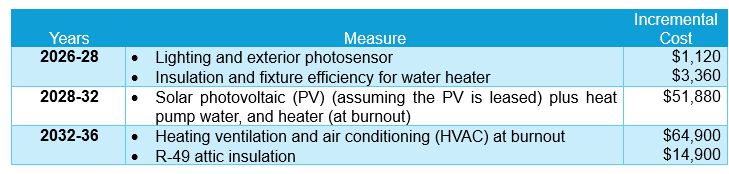
The performance mandates are tiered over time and greatly increase in expense for rental housing providers with the first interim performance standard deadline of May 15, 2028, a second interim performance standard deadline of May 15, 2032, and a final performance standard deadline of May 15, 2036.
For a 20-unit multifamily property, below is one cost scenario from the city staff’s report.
In addition, penalties for not meeting the deadlines are up to $10 per square foot based on the building’s gross floor area.
This means that a 20,000 square foot property owner could face a penalty of $200,000.
Additionally, if a property is sold by the current owner, there is a new disclosure requirement that must be included in the sale agreement, which states:
Buyer is aware that the City of West Hollywood has adopted requirements for building energy benchmarking and performance of different types of buildings. The requirements can be found in West Hollywood Municipal Code Chapter 15.100. For more information on which types of buildings are required to comply with energy benchmarking and performance standards, Buyer is advised to contact the City of West Hollywood Community Development Department.