
Local Advocacy Update: L.A. County Declares Storm Emergency and Much More!

Local Advocacy Update: L.A. County Declares Storm Emergency and Much More!
By Janet Gagnon, Chief Corporate Affairs Officer & Senior Vice President, Government Affairs
During the past month, the Apartment Association of Greater Los Angeles’ (AAGLA) local government advocacy team was once again engaged in advocating on multiple issues impacting our members. At the time this article was written, some of the matters covered herein had not yet been finalized – always be sure to look for our email alerts for further updates. The following is a summary of some of the most pertinent issues.
Los Angeles County Passes Storm Emergency Declarations
On November 25th, the Los Angeles County Board of Supervisors unanimously approved two storm emergency declarations authored by Supervisor Lindsey Horvath and Chair Kathryn Barger, respectively. The ordinances trigger the County’s existing anti-price gouging ordinance restrictions. Chair Barger’s emergency declaration goes into effect immediately, while Supervisor Horvath’s will become effective later. Once Supervisor Horvath’s emergency declaration becomes effective, that will remain in place through and including December 28, 2025, at which time it could be renewed. Chair Barger’s motion is similar; however, with no end date and without the price-gauging accusation.
AAGLA strongly opposed both motions, arguing that another emergency declaration will only further destabilize the rental housing market by restricting rental housing providers from increasing rents. Using the excuse for yet another emergency declaration on a normal winter rain merely leads us further down the slippery slope of using just about any occurrence as a basis to declare an emergency and impose anti-price-gauging rules.
Given the frequency of such emergency declarations and the ever-expanding definition of what constitutes an emergency, it appears that the Supervisors are now seeking to do an end-run around state law that prohibits rent stabilization on newly constructed multifamily properties and properties exempt from local or state rent control, such as single-family residences. Due to the frequency of declared “emergencies”, the County Supervisors are using the anti-price gouging ordinance as a de facto rent stabilization ordinance.
In general, under anti-price-gauging rules, rental housing providers of any type of property, whether multifamily, single-family, condominium, townhouses, or accessory dwelling units throughout the County may not increase rent by more than 10% until the end of the declared emergency. Additionally, Supervisor Horvath’s emergency declaration accuses housing providers of engaging in price gauging without basis or study, and it continues to limit rent increases to 200% Fair Market Rent (as determined by the U.S. Department of Housing and Urban Development, or “HUD”) for setting pricing on rental units that are either new to market or had been vacant for one year or more. There are limited exceptions to the anti-price-gauging rules, and members should seek legal counsel for guidance on their specific situation.
Glendale Adopts New Heat-Pump or Energy Efficiency Mandates
On November 18th, the Glendale City Council passed a new ordinance that requires duplexes, town homes and single-family properties to install either a heat pump as the primary source for heating or conduct additional energy efficiency measures when replacing or newly installing air conditioner units for cooling. In addition, air conditioning systems being replaced must also meet several new requirements under the ordinance. The new ordinance will be effective on December 18, 2026.
AAGLA had aggressively opposed this new ordinance for many reasons, including that it was passed without proper study that included relevant cost data, and that electric heat pumps will be far more costly for tenants than gas appliances. This ordinance is illogical because heat pumps can be used for both cooling and heating, but the ordinance requires the installation of heat pumps for heating only when replacing air conditioners for cooling. Additionally, AAGLA attempted to eliminate the requirement from being imposed on duplexes as multifamily properties, with the vast majority of these properties used for rental housing, since any “life of system” use benefits do not apply to rental properties.
Pomona Passes Permanent Rent Stabilization
On November 17th, the Pomona City Council voted to pass a new permanent rent stabilization ordinance. Council Member Debra Martin was the sole opposing vote, stating that she supported stronger code enforcement instead of a permanent rent stabilization ordinance. The new ordinance replaces the two existing urgency ordinances and is effective as of January 1, 2026. The new permanent ordinance raises the fixed annual allowable increase from 4% to 5%. However, it is still not tied to the Consumer Price Index. Therefore, when inflation is above 5%, owners will not be able to keep pace with rising costs.
Also included in the ordinance are costly relocation fees that are based on rental rates from Los Angeles County that were, at the time of the City’s study, 34% greater than Pomona's, and that are today 37% greater than average rental rates in Pomona. While the City Council did not address this major discrepancy, the ordinance contains a sunset provision of December 31, 2026, when this issue could be addressed again. However, such costly relocation fees will make it difficult and unaffordable for most owners, particularly moms and pops, to complete major repairs requiring relocation of residents through a no-fault eviction process.
During the November 17th City Council meeting, Mayor Sandoval indicated his desire to again bring back the issue of creating a costly (and unnecessary) rental registry at a time when the City is already facing a severe budget crisis. As always, we will keep our members updated should a rental registry or other harmful policies appear on future agendas.
Santa Monica Adopts Rental Registration Requirement for All Non-RSO Rentals
On November 18th, the Santa Monica City Council unanimously passed a new ordinance that requires all rental housing providers to register all rental units with the City. The ordinance applies to all residential rental properties not subject to the City’s Rental Stabilization Ordinance, including duplexes, single-family, condominiums, town homes, accessory dwelling units, and junior accessory dwelling units, as well as all non-rent-stabilized multifamily properties. The ordinance takes effect on January 1, 2026.
The ordinance does not specify the amount of the rental registration fee or administrative fines, which will be set later. However, the ordinance does specify civil penalties for non-compliance of $200 per unit per month. Further, non-compliance with the ordinance can be used by renters as an affirmative defense against any legal action by the property owner to recover possession of the rental unit. Starting January 1, 2027 (one year after the effective date), rental housing providers who have not registered their units will not be entitled to collect rent.
In addition, rental housing providers will be required to provide specific information when registering their units, including reasons for vacating the unit. Of course, no owner can force a renter to provide such information nor verify its accuracy, and as a result, the City will be tracking information that is speculative at best.
The reason given by the City for this rental registration requirement for non-rent stabilized properties is to use the information as a basis for enforcement of state law under the Tenant Protection Act of 2019 (Assembly Bill 1482) that limits annual rent increases for multifamily properties built more than 15 years ago to the Consumer Price Index plus 5% or a maximum of 10%, whichever is lower. In addition, the City will use the data from rent registry to enforce state anti-gouging law during declared emergencies and also to enforce several existing local ordinances, including: (i) notification to the City of any unlawful detainer actions, (ii) anti-harassment, (iii) just cause evictions, (iv) relocation assistance for no-fault evictions, and (v) tenant buyout agreement requirements.
West Hollywood Passes Building Performance Mandates
On December 1st, the West Hollywood City Council unanimously adopted an ordinance requiring all rental properties having 20,000 square feet or more to conduct expensive benchmarking, third party data verification and mandates for performance improvements. The ordinance goes into effect on December 31, 2025. The performance mandates are tiered over time and greatly increase in expense for rental housing providers with the first interim performance standard deadline of May 15, 2028, a second interim performance standard deadline of May 15, 2032, and a final performance standard deadline of May 15, 2036. For a 20-unit multifamily property, below is one cost scenario from the city staff’s report.
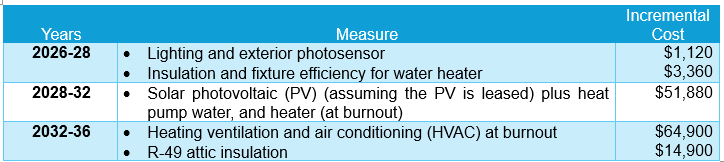
In addition, penalties for not meeting the deadlines are up to $10 per square foot based on the building’s gross floor area. This means that a 20,000 square foot property owner could face a penalty of $200,000. This is purposeful by the City Council as they claim they want to make the cost of conducting the required building improvements (which are expensive) less expensive than the penalties to encourage compliance. Additionally, if a property is sold by the current owner, there is a new disclosure requirement that must be included in the sale agreement, which states:
“Buyer is aware that the City of West Hollywood has adopted requirements for building energy benchmarking and performance of different types of buildings. The requirements can be found in West Hollywood Municipal Code Chapter 15.100. For more information on which types of buildings are required to comply with energy benchmarking and performance standards, Buyer is advised to contact the City of West Hollywood Community Development Department.”
This article does not constitute tax or legal advice and is for informational purposes only. If you have questions concerning your specific situation and the requirements of any regulations discussed herein, please consult with a licensed professional.